
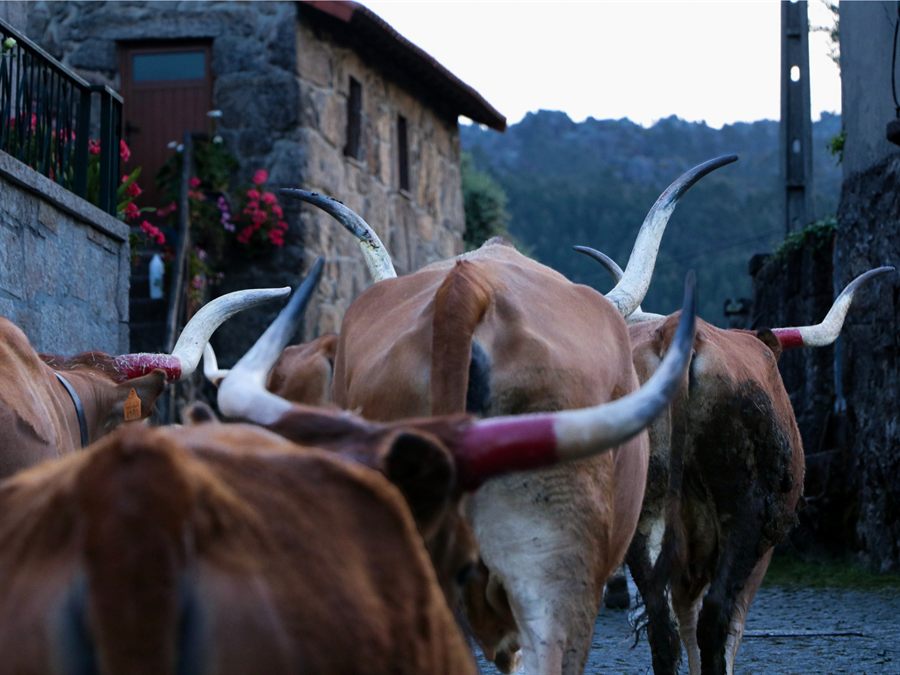
Since 2024, a European research project called Cultur-Monts has been working with the people of Peneda-Gerês to give the park’s mountain heritage a future. In Portugal it has focused on three threads of the landscape: the Geira Roman road, the old transhumance trails and the bread cycle of Extremo. This November its partners met in Braga to take stock, as the project nears its scheduled end.
At a glance
- What: Cultur-Monts, a European cooperation project on mountain cultural landscapes in Portugal, Spain and France
- Who: led by the Catalan Institute of Classical Archaeology; in Portugal, the University of Minho and ADERE-PG, the development association of the Peneda-Gerês regions
- Where in the park: the Geira in Terras de Bouro, old transhumance trails, and the parish of Extremo in Arcos de Valdevez
- When: January 2024 to December 2026, with a possible extension
- Funding: Interreg Sudoe 2021–27; about €1.69 million in total, of which about €1.27 million from the European Regional Development Fund
- Emergency: call 112
- Last checked: 13 November 2026
What Cultur-Monts is
Cultur-Monts stands for “Valorisation of Mountain Cultural Landscapes: a resource for sustainable territorial development”. It brings together research centres, universities, local authorities and associations from Portugal, Spain and France. The lead partner is the Catalan Institute of Classical Archaeology (ICAC), in Tarragona.
The project works in seven mountain areas, from the Massif Central in France to the Pyrenees, the Cantabrian Mountains and, in Portugal, Peneda-Gerês. Its starting point is a problem these places share: depopulation and an ageing population. According to Diário do Minho, the response is to strengthen three things together: heritage, local social structures and local production.
The Portuguese partners are the University of Minho, through its Institute of Social Sciences and the Lab2PT research centre, and ADERE-PG, the development association of the Peneda-Gerês National Park regions. The municipalities of Terras de Bouro and Arcos de Valdevez take part as associated partners.
The Peneda-Gerês chapter
In the park, Cultur-Monts has followed three ways in which people have shaped and used the mountains.
- The Geira. The Roman road between Braga and Astorga crosses Terras de Bouro, and is one of the park’s best-known historic routes. In October 2024 the University of Minho team led a visit to the ‘Adro Velho’/‘Sagrado’ archaeological site in São João do Campo, showing about 80 local people and teachers the ongoing work on the road and the quarries used to build it, according to Interreg Sudoe. Read more in our guide to walking the Geira.
- The transhumance trails. The project also studies the old paths along which herds were moved between pastures.
- The bread cycle in Extremo. In the parish of Extremo, in Arcos de Valdevez, the project follows bread from field to oven. In November 2024 it launched a socio-cultural innovation cluster for the park there, with a workshop on place names and oral memory, and a community meal with bread from the village bakery, the last link in that cycle.
Rebeca Blanco Rotea, a researcher on the project and at Lab2PT, told Diário do Minho that the team’s work with these communities began in 2018, well before Cultur-Monts. The University of Minho’s lead researcher is Helena Carvalho.
What stays behind
The closing meeting, the project’s ninth, ran until 12 November at the São Francisco convent in Real, Braga. The coordinator, Josep Palet, director of ICAC, described the results as very positive.
In the park, the project is leaving some lasting work:
- Escola do Território. With the University of Minho’s School of Architecture, an old primary school will become a multipurpose space for the community.
- Routes and panels. Signposted routes and information panels on the Geira and on the bread cycle are planned.
Cultur-Monts is due to end this year, but it may be extended. If so, Diário do Minho reports, the next phase would focus on intangible heritage: memories and the ties that hold communities together.
Visit with respect
The heritage Cultur-Monts works with is not a museum piece. These are lived-in landscapes, and they belong to the people who live here.
- On the Geira, stay on the road and leave milestones and stones where they are. Archaeological sites are fragile.
- In the villages, ask before photographing people, homes or animals, and keep gates as you found them.
- Buy local. Bread from a village bakery or a meal in a local restaurant keeps the cycle the project studies alive.
In an emergency, call 112.
Sources
- Diário do Minho — Projeto europeu dinamizado pela UMinho revitaliza património da Peneda-Gerês (10 Nov 2026)
- Interreg Sudoe — Cultur-Monts project page
- Interreg Sudoe — New socio-cultural innovation cluster in Portugal (21 Mar 2025)
- ICAC — Cultur-Monts (2024)
- University of Minho — Lab2PT
- Gerês-Xurés Biosphere Reserve — ADERE-PG
A Roman road, a shepherds’ path, a loaf of bread: Cultur-Monts treats them as one landscape, and as a reason for people to stay. The next time you walk the Geira, you are walking through that work.
The international reference guide to Peneda-Gerês National Park — Portugal's only national park. Nature, culture and silence to protect for future generations.
Visit
Official websites
Discover
Scientific resources
This website
Emergencies
Social Media
Independent guide — this is not the park's official website. For official information see ICNF and Visit Portugal.